Seven Dials Club
The Seven Dials MysteryThe Seven Dials Club is a London nightclub at 14 Hunstanton Street, a tall house in a narrow street, whose ordinary-seeming entertainment spaces conceal a secure chamber used by the Seven Dials Society. Its contrast between fried fish, dancing, and smoky cellar rooms on one level and carefully engineered secrecy on another makes the Club a physical model of the novel’s recurring gap between appearances and reality.
Setting and Public Face
Bill Eversleigh explains the Club to Bundle Brent as a fading social craze: people had gone there to say they had visited, but the place had become less fashionable. The district around Tottenham Court Road had once been poor and shabby, he says, and had since been cleared and cleaned up; the Club retained an old-fashioned atmosphere, with fried fish and chips and deliberate squalor. It was accessible after the theatre and drew a mixed crowd of artists, unconventional women, and members of Bill’s social circle. Bill dismisses reports of more consequential activity as talk intended to attract customers, a casual judgment that makes the Club’s hidden purpose easier to overlook.
Bundle and Bill arrive by taxi at 14 Hunstanton Street. The exterior is a tall house on a narrow street; inside, the cellar is crowded, smoky enough to veil its occupants in a blue haze, and filled with the overpowering smell of fried fish. Bill takes pleasure in presenting the place, while Bundle studies it. The busy, unremarkable entertainment venue gives her access without requiring a conspicuous approach to a suspected secret organization.
Hidden Rooms and Security
The Club’s back rooms turn its public disorder into useful cover. When Bundle confronts Alfred about his employment at Chimneys, he admits that the premises have been raided twice, but says that Mr. Mosgorovsky’s arrangements ensured that nothing compromising was found. A concealed exit from the gaming room leads through another room to a staircase opening onto the next street, allowing patrons to leave during a raid. The exit resembles a cupboard, and its ingenuity depends on its being mistaken for ordinary furnishing.
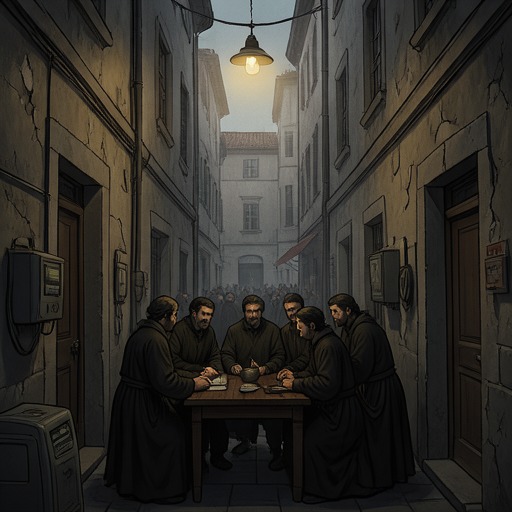
Bundle discovers that a key from among the downstairs keys will open the hidden door. Beyond it lies a small, dingy room with a long central table, chairs, and two built-in cupboards beside the fireplace. One cupboard has a special lock; when open, it appears to be an ordinary cupboard containing shelves and ledgers, but a concealed point makes the whole structure swing open. The room’s entrance is carefully edged with baize, making it soundproof. Its furnishings reveal an arrangement that the Club’s noisy public rooms disguise: seven chairs, three on either side of the table and a more imposing seat at its head.
The room’s architecture serves several purposes at once. It can be reached through the gaming room, where a raid would offer an innocent explanation for secrecy, or by the concealed entrance and escape route. The soundproof door, disguised cupboard, and hidden passage provide concealment and controlled movement; the seven seats give Bundle a further clue that the chamber is a meeting place, not simply a nightclub storeroom. The scene turns practical details into evidence: the room’s carefully designed secrecy exposes the existence of an organized group.
Bundle’s Discovery and the Secret Meeting
Bundle suspects that the chamber is used by the secret organization and waits inside a cupboard, interpreting the room’s cleaning as a sign that a meeting is imminent. The wait lasts four hours, in a cramped hiding place, before she hears a door being unlocked. From her concealment she witnesses a masked meeting. The discussion confirms that the members fear that their activities and the Club are attracting suspicion; one speaker says that people who know too much must be silenced. Bundle’s discovery therefore changes the room from a puzzle into a place of immediate danger.
The meeting also connects the Club to the wider investigation. Mr. Mosgorovsky asks about the letter from Gerald Wade that mentions the organization and learns that Bundle found it. The members discuss the approaching inquest on Ronald Devereux and the spreading of a false account about local men practising with rifles. They also refer to plans already seen by the group and to the invention associated with Eberhard. In this private chamber, the Club’s concealed function becomes legible through the members’ talk: it is a base for planning and managing secret operations, not merely a place whose atmosphere encourages rumours.
Return, Confinement, and Revelation
Later, Bundle returns to the Club with Bill and Loraine Wade, warning Alfred that the police are after him. Bill asks for the key to the room Bundle entered previously, and the group goes back through the hidden interior. The chamber becomes a site of confinement as well as discovery: Bundle finds herself and Bill shut inside it, with the baize door closed and apparently locked. Its soundproofing and concealed access, once useful to the organization, now prevent them from simply leaving or summoning help.
Mr. Mosgorovsky eventually leads Bundle downstairs to an emergency meeting. She enters the same chamber again and sees the masked figures seated around the table, this time with No. 7 occupying the prominent chair at its head. The room’s repeated appearance sharpens the contrast between the masked spectacle and the more prosaic reality Superintendent Battle explains there. Battle rejects Bundle’s assumption that the Society is a criminal organization ruled by an unseen supercriminal: its members are amateurs who have undertaken dangerous secret work for his department and to serve their country. Mr. Mosgorovsky runs the Club and is also described as the department’s most valuable secret anti-Bolshevist agent in England.
Narrative Significance
The Club’s importance rests on its double use. The public venue’s crowds, smoke, gaming, and reputation for shabby nightlife provide cover; the hidden passage, soundproof chamber, and concealed cupboard make that cover operational. What first looks to Bundle like a criminal headquarters is ultimately revealed as the meeting place of an amateur intelligence group, so the same architecture supports both genuine secrecy and a misleading impression of criminal power.
The building also structures Bundle’s investigation. She reaches it through ordinary social knowledge supplied by Bill, recognizes its concealed room through observation rather than an official inquiry, and risks remaining hidden there long enough to witness a meeting. On her return, the room physically traps her before becoming the setting for the explanation that overturns her assumptions. The Seven Dials Club is therefore not just a backdrop: its carefully divided spaces organize the novel’s movement from public rumor to concealed evidence, from apparent menace to clarified purpose.